11 Aug
If you have ever encountered the term “Mashallah” in the context of a Muslim person who is discussing something beautiful, receiving good news, or about to compliment someone, you probably want to know what is mashallah meaning.
Mashallah (ما شاء الله) is one of the many Arabic expressions that people from Islamic faith use in various situations. The term implies the fact that something beautiful, good, or inspiring took place according to Allah’s will. For example, Muslims may say Mashallah while admiring a baby, congratulating someone for his or her success, enjoying something pretty, or hearing about some blessing.
But Mashallah is more than just a word that denotes surprise. Rather, it represents a Muslim’s belief in the fact that every blessing comes from Allah.
The purpose of this article is to shed light on the essence of the word Mashallah in English, its meaning in Arabic, its importance for the Muslim believers, situations when the term is used by Islamic followers, the proper way of writing the word in Arabic language, and the difference between it and Inshallah.
What Does Mashallah Mean?
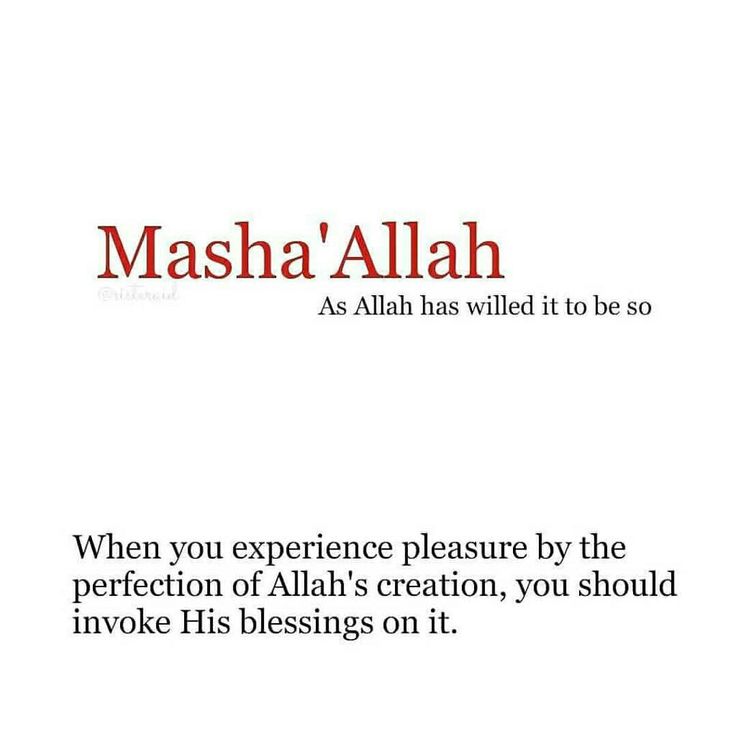
Mashallah (ما شاء الله) is commonly translated as follows:
“What Allah’s will is.”
It can also be interpreted as:
“As Allah has wished.”
This phrase is used to indicate that some event has happened due to the wish of Allah.
Mashallah Meaning in Arabic
In Arabic, Mashallah is written:
“ما شاء الله”
It is made up of words that relate to Allah’s will:
- ما (Mā) – what
- شاء (Shā’a) – willed or wanted
- الله (Allah) – Allah
Together, ما شاء الله conveys the meaning of “what Allah has willed.”
When should we say Mashallah?
Mashallah can be used in many situations, not only in certain cases. Muslims typically say it when they are pleased or admire something.
Below are a few situations when it is appropriate to use Mashallah:
- When Giving a Compliment
If you are providing a compliment on someone’s looks, character, accomplishments, or talent, you will likely hear Muslims saying:
“Mashallah, you look so beautiful today.”
- When Talking About a Child
When someone is admiring a child, parents or relatives could say Mashallah.
Example:
“Mashallah, your daughter is growing up so fast.”
- When Talking About an Achievement
If a friend graduated from school, found a new job, memorized Qur’an, or did something substantial, you might say:
“Mashallah, I’m happy for you!”
- When Talking About a Beautiful Thing
Mashallah can also be used when admiring something beautiful, like someone’s house, garden, landscape, painting, or Qur’an recitation.
- When Talking About Your Own Good Fortune
Finally, a person could say Mashallah when talking about their own good fortune that happened to them thanks to Allah.
Example:
“Mashallah, we are blessed to have a house!”
The basic thought is that the person acknowledges the
Why do muslims say Mashallah?
Saying MashaAllah means something to Muslims beyond admiration, it is a way of linking the daily joy, beauty, and victory with faith in Allah.
So doing, when Muslims say MashaAllah (ما شاء الله), they acknowledge the existence of something good thanks to Allah’s will rather than the object of blessing.
- To Recognize Blessings of Allah
Islam believes that good things in their life are blessings from Allah and saying MashaAllah can serve as the reminder.
The success of a person, family, health, knowledge, abilities, or possessions should not be considered distant from Allah’s love.
- To Encourage Gratitude and Humility
People can sometimes lose track of their blessings when they experience success. MashaAllah reminds us to always practice gratitude and humility.
Achievements such as getting a degree, starting a family, memorizing the Quran, or obtaining the latest job offer can deceive a person into thinking that those successes were achieved solely through their own hard work. A simple phrase like MashaAllah can remind a person that every achievement, accomplishment, and circumstance is a blessing from Allah.
We are saying that this is not limited to a mere compliment; it can also remind a person of the source of the blessing.
- To Keep the Presence of Allah in One’s Life
Muslims should not only remember Allah during prayers and formal acts of worship, but also in their everyday life.
MashaAllah, Alhamdulillah, and Inshallah are just a few examples of how Islam can make its way into everyday speech without being affected by individual’s beliefs.
Utilizing the expression MashaAllah while being impressed with something can help one associate the moment with an idea of Allah.
- It has been claimed that Muslims say MashaAllah to avert the evil eye
Although the evil eye is a concept in Islam, it does not mean that MashaAllah is a magical word or something that protects against the evil eye.
The term Mashllah is used mainly to express the acceptance of the wish or blessing of Allah
Muslims who want to avoid the evil eye should use the relevant Islamic prayers instead of relying on the term MashaAllah viewed as some kind of magical cure for the evil eye.
Is MashaAllah mentioned in the Quran?
Yes, the term MashaAllah (ما شاء الله) appears in Surah Al-Kahf (18:39). The narrative of two men and their gardens is where the phrase occurs for the first time, whereby the faithful man reminds his friend to say the name of Allah when entering the garden.
Allah says:
وَلَوْلَا إِذْ دَخَلْتَ جَنَّتَكَ قُلْتَ مَا شَاءَ اللَّهُ لَا قُوَّةَ إِلَّا بِاللَّهِ
“If only you had said, upon entering your property, ‘This is what Allah has willed! There is no power except with Allah!’”
— Quran 18:39
The term MashaAllah is derived from the Arabic term مَا شَاءَ اللَّهُ (Mā shā’a Allāh) in this verse, which suggests that whatever happens is the result of the will of Allah.
More about the translation of this verse in various languages can be found on Quran.com in both Arabic and English.
Mashallah vs. Inshallah: What’s the Difference?
| Inshallah (إن شاء الله) | Mashallah (ما شاء الله) | |
| “If Allah wills” | “What Allah has willed” | Meaning |
| Before something is hoped or planned to happen | After something good has already happened | When it’s used |
| Future — expressing hope for what’s to come | Past / present — reflecting on a blessing | Tense |
| “Inshallah, I’ll get the job.” | “Mashallah, your new job is amazing!” | Example |
Briefly: Mashallah is a way to acknowledge a blessing that has happened, and Inshallah is a way to hope for something to happen, and leave it to Allah’s will.
Conclusion
MashaAllah is a short phrase that embodies a great idea: beauty, fortune, and every success in life is indeed a gift, but never a guarantee. It can be used to say anything good about anything from a newborn’s appearance to a graduation or a flourishing garden and even your inner bounty. Whenever you want to acknowledge good things and remember that everything is a gift from Allah, you should mention Mashallah.
Knowing the circumstances when Muslims use the term Mashallah gives you a better opportunity to understand Islam.
In case you are searching for other Islamic terms related to everyday activities, you could be also interested in reading our article Bismillah Meaning , the term that Muslim people use on a regular basis to ask Allah for blessings before starting something new.
If you have a desire to learn more about Arabic and follow the full concept of Islamic terms such as Mashallah, then check our Arabic Language and Islamic Studies courses. Go beyond rote learning of the words as you learn what they mean and what their precise usage in Muslim everyday life is.
Are you ready to begin learning? Book your free trial today!
Frequently Asked Questions
Is it “Mashallah” or “MashaAllah”?
Both variations are correct and accepted. “MashaAllah” better captures the meaning of the three Arabic words ( مَا شَاءَ ٱللَّٰهُ ) while “Mashallah” is the most popular form when translated into English.
Can a non-Muslim say Mashallah?
Yes, although it originates from a religious context in Islam, it is a phrase that is understood more broadly as a kind compliment, creating positive impact on the listener, be it a Muslim or a non-Muslim person.
What are the differences between Mashallah and Alhamdulillah?
The first term is usually used when expressing admiration about something, while Alhamdulillah is a phrase used for the purpose of expressing gratitude on a broader scale.
Is the expression Mashallah limited to compliments?
Not exactly; Mashallah can be used in cases where there is recognition of blessings received personally or admiration of beauty or noteworthy achievements, among other situations.