) -->
Arabic Morphology for Beginners

Learn Arabic Morphology for Beginners: Gold Tips

Arabic morphology for beginners is one of the most crucial aspects of mastering the language. Morphology, or the study of the structure of words, is very instrumental in determining the meaning and functions of words in a sentence. Think of morphology in Arabic as a kind of puzzle where every word acts as a part of the whole picture. Learning the foundational rules of how words are constructed makes beginners able to unlock such complexities in the language and appreciate its details.

What is Arabic morphology?

Morphology is a fundamental area of Arabic grammar that focuses on the form and formation of words. It examines how words are constructed from smaller, meaningful units known as morphemes. It is the area of linguistics concerned with the internal structure of words, patterns of vowelization, the addition of extra letters, and the application of templates that guide the construction and modification of words.

Arabic morphology for beginners is crucial for achieving proficiency in the language. If mastered well, it would be easy for them to effectively decode the relationships between different word forms and their meanings, which is important in ensuring grammatical accuracy and semantic clarity.

A closer look at Arabic words

Generally, Arabic words are formed of three categories that have a very important structure and meaning in the Arabic language.

1.Nouns

Such as nouns, pronouns, adjectives, and adverbs, it holds the biggest group of words. Nouns are the brickstones of Arabic since they outline the bones of the sentence and hold the actual meaning of the text.

2.Verbs

Verbs are dynamic elements that describe actions, states, or events. They get controlled by the Templatic system that makes their conjugation and patterning. As such, it allows the emergence of a rich range of meanings taken by verbs as they pattern from one form to another, enriching their depth. Mastery of the rules relating to verb conjugation and change is the key to good expression in Arabic.

3.Particles

Particles are unlike nouns and verbs in that they are not subject to the templatic system. They are unpredictable and never make morpho-phonemic changes, and as such, they are invariable. There are a rather limited number of particles in Arabic, but without them, it is impossible to form grammatically correct sentences or link ideas together coherently. Their irregularity means they have to be memorized.

This is one of the fundamental Arabic grammar rules that beginners must learn to understand Arabic morphology for beginners.

Some morphology-related features 

In this section, we will discuss some elements from the treasures of Arabic morphology that are important for students to understand and digest.

  • The Root and Pattern System (Templatic System):

This explains how to extract many words from one root by applying specific vowel patterns to that one root. Let’s simplify it with examples:

  • First and foremost, the root is the soul of the word. In most cases, it is made up of three consonants. These consonants carry the core semantic content of a word.

Example: the Arabic verb رَسَمَ in English means draw, this will work as the basis for various words related to the concept of drawing.

The root provides the core meaning that is extended and modified through different patterns and affixes to be transformed into words.

  • Secondly, the pattern, oatterns are vowel templates and sometimes include additional consonants that are applied to the root to create different words. These patterns modify the root to form various grammatical forms and meanings.

Example: When applied to the verb رَسَمَ, it becomes a noun meaning the place itself: مرسم.

  • The building blocks of word formation
  • Prefixes: are added to the beginning of a root word to generate new different meanings or to indicate certain grammatical features. 

Examples: (ال), (ب), (س). Each one has a purpose; ال is a definite article meaning “the”. Then we have ب in English means by, while س indicates the future.

  •  Suffixes: These are added to the end of a word, and used to indicate possession, verb conjugation, plurality, etc.

Examples:  ي letter in قلمي , the letter ك in كتابك (your book), the letters ون in مسلمون ( pulsar form of Muslim)

Arabic syntax and morphology interaction

Arabic syntax and morphology are intricately linked, working together to create meaningful sentences and convey balanced meanings.

Defining syntax:

Arabic syntax refers to the rules governing word and phrase arrangement, primarily distinguishing between two types of sentences: 

1- Nominal sentences, which begin with a noun or pronoun. 

2- verbal sentences, which start with a verb.

While the standard structure for verbal sentences is verb-subject-object (VSO), modern spoken Arabic often adopts a subject-verb-object (SVO) order, showcasing the language’s flexibility. 

Morphology, on the other hand, involves the study of word forms and patterns, including how nouns, pronouns, and adjectives change their endings based on their grammatical roles; known as case markings.

Some examples for clarification:

Nouns may take on nominative, accusative, or genitive endings depending on whether they function as subjects or objects in a sentence. This morphological variation is quite important in the maintenance of subject-verb agreement, whereby a verb is supposed to agree with its subject in gender and number, while an adjective is supposed to agree with the noun it modifies.

The interaction of syntax and morphology enriches the structure of the Arabic sentence while increasing clarity, and the expressiveness of the language.

What are the key steps to learning Arabic morphology?

1- First of all, you need to understand the common roots of the words, as they are the essence of many words.

2- You should become familiar with common patterns that are used to modify roots into different forms.

3- Undoubtedly, regular practice in applying roots and patterns to real words will help improve and elevate your experience. 

4- Flashcards for roots and patterns are one of the most funny and innovative methods to check your understanding.

5- You better learn words in sentences to see how morphology affects meaning and grammar.

6- Join Arabic language classes, In these classes you will get structured guidance from experienced teachers.

7- Consistently review what you’ve learned to solidify your understanding.

Morphology importance to read the Quran

Understanding Arabic morphology is essential for effectively reading and interpreting the Quran.

  • Understanding the text.
  • Morphology affects verb forms and noun cases. Knowing case endings is essential for understanding the roles of nouns and adjectives in Quran verses.
  • Understand the meaning in context, as morphological variations in meanings may change.
  • Allowing the scholars the room to give the right interpretation.
  • Mastering the morphological rules instructs about pronunciation and enhances tajweed and recitation.
  • Arabic morphology for beginners will help the non-native speaker learn and memorize verses, by mere recognition of the pattern or structure of the words.
  • Morphological analysis helps maintain the Quran’s linguistic integrity so that its meanings can be conveyed in their original context.

How the phonology and morphology of Arabic interact together 

Phonology is the part of linguistics that deals with the systematic organization of sounds in languages. It deals with the understanding of how sounds function in a particular language or languages in general by studying the patterns and rules governing the sound system.

The phonology and morphology of Arabic are intricately intertwined, with each component influencing the other to create the rich and complex structure of the language.

Morphophonemics, which studies how sound rules apply to word parts (morphemes), is key to this interaction.
Here is an example to simplify it:  When the definite article “الـ” (al-) is added to a noun beginning with a “sun letter the “l” drops and assimilates into the following consonant, so “الشمس” (ash-shams), for “الشمسي” (al-shams). This shows that phonological rules can have implications for how morphemes combine. Furthermore, changes in word forms, such as verb conjugations may also cause changes in vowels, or stress. Overall, The interaction of phonology with morphology in Arabic enriches the language and makes it very expressive.           

Learn Arabic morphology at Noor Institute

At Noor Institute, students will be pleasantly surprised at just how easily they are able to start enriching themselves in the learning process of Arabic morphology for beginners. This course gives an introduction to the science of Arabic word formation, focusing on its core modules. The emphasis of the programs is on practical methodologies whereby common phrases will be broken down and color associations will be used for morphological patterns; making the learning process engaging and effective. 

Noor Institute offers beginners the chance to decode the complexities of Arabic morphology through targeted exercises and real-world examples, with a curriculum structure that provides a solid foundation for subsequent advanced study and comprehension of the language.

Frequently asked questions

  • Is it hard to learn Arabic morphology?

Arabic morphology for beginners may be a bit challenging as morphology intersects with many areas including roots and patterns. However, with constant practice and guidance, it can be manageable.

  • what is the verb conjugation?

Simply, it is a change in form to express a different tense, mood, voice, person, number, and sometimes gender.
how long does it take to read Arabic

How long does it take to read Arabic?

Arabic is one of the most widely spoken languages in the world, ranking as the 4th most spoken language globally as of 2021. As the language of the Quran, many non-Arabic speakers seek to learn to read Arabic as it provides access to Islamic teachings and scholarship. If you are curious to find out how long does it take to read Arabic, then you have come to the right place.

In this blog, we will dive deeply to understand the history of the arabic language in addition to its unique features. We will also provide some useful tips for improving different skills. Finally, we will introduce one of the best Islamic communities as a reference for learners.

History of the Arabic language

The Arabic language has a rich and extensive history dating back over a millennium. It is of Arabian origin, with its first speakers the nomadic tribes who occupied the northwestern portions of present-day Saudi Arabia. As a Semitic language, it shares linguistic ancestry with Hebrew and Aramaic.

Initially, Arabic was written without dots and diacritical marks. This unmarked script was used until the mid-7th century CE. As the Islamic empire expanded through conquests, Arabs encountered people from various cultures and languages. This significant cultural exchange raised concerns about potential misinterpretations and distortions of the Quran. 

The purpose behind dotting Arabic letters

The purpose behind dotting Arabic letters

In an initiative to preserve the accuracy and integrity of this holy text, scholars began introducing dots and diacritical marks into the script. On the one hand, these changes gave place to the correct pronunciation and meaning of Quranic verses; on the other hand, they provided for a more accurate and uniform written form of Arabic.

The introduction of diacritical marks to the Arabic script lent it a standardized character and hence presented a turning point in the history of the development of the Arabic language. This ensured that different regions of Muslims could correctly read the Quran, thus safeguarding the linguistic and spiritual tradition of Arabic. Over many centuries, Arabic has further grown and become the lingua franca of the Islamic world and a considerable medium for science, literature, and philosophy. Today, it is spoken by millions around the world, and it forms a cultural and religious base in the Arab world.

The unique features of the Arabic language

  • Arabic is the language of the Quran and Hadith.
  • Since it is the only language in the world that includes the letter Dad (ض), It is called the language of the letter Dad.
  • It is known for strength, solidity, and rich vocabulary that you can hardly find in any other language. The letters are pronounced distinctively, forming melodies that don’t exist in other languages
  •  It consists of twenty-eight letters, which is fewer than the number of letters in many other languages.
  • Arabic is characterized by being written from right to left. There is no other language in the world except Persian which has this unique feature.
  • The Arabic language is rich, it has many grammar rules that govern how each word is pronounced.

How long does it take to learn to read Arabic?

The duration needed to learn the Arabic language is unknown, it depends on many factors. These elements factors include:

  1. Your current level of proficiency: This makes a huge difference. Whether you are starting from scratch, having limited knowledge, or even having studied Arabic a little before will make a huge difference in how far along the path you can get. 
  2. Study time and practicing plan: This is the most important factor of them all. It means the quantity of time one can dedicate to studying and practicing a target language. If you can continuously practice with focus, that will definitely speed up your learning process. 
  3. learning environment: The environment you surround yourself with may affect the way you learn a language.

The process may be broadly categorized into three phases, each with its difficulties and milestones.

Beginner Phase

At the foundation phase of learning Arabic, you learn the 28 alphabets and their different forms according to the position of the word.

Intermediate Phase

After learning the Arabic alphabet, you would then move on to the next step of forming words and basic sentences. Through this phase, comprehension and most vocabularies are enhanced further by learning word patterns and roots. This stage usually takes a few months depending on your practice and dedication.

Advanced Stage

At this level, you are going to read complex texts such as novels and academic articles, where you will encounter difficult words, grammatical structures, and idioms. Proficiency can last from one to several years of study.

How long does it take to read the Arabic alphabet?

How long does it take to read the Arabic alphabet?

In most cases, it requires several weeks or months of serious study to get familiar with the letters, sounds, and diacritics. Each letter has a unique shape and pronunciation. Making yourself familiar with these basics is critical for reading and understanding. The duration of learning can vary depending on your background, prior experience with similar scripts, and the intensity of study.

Provided that you practice regularly and proceed in an orderly fashion, then within this time frame, you will be able to attain at least a basic proficiency in reading the Arabic alphabet.

It is important to mention that learning the alphabet is not enough to learn reading, Arabic letters look different in words than they do in their isolated forms. The sounds, that the letters make in words, differ from the names of the letters.

How to improve the 4 skills of learning Arabic?

How to improve the 4 skills of learning Arabic

Improving the four essential skills of learning Arabic requires a balanced approach and consistent practice. Here are some strategies for each skill:

1- Reading

  • Try to start with simple text then move to more complex pieces.
  • Note down all new vocabulary to expand your word count
  • Regular and daily practice is the key.

2- Writing

  • Start writing, this is important. You need to start using the words you just learned. Try writing short paragraphs or writing your diaries.
  • Be sure to pay close attention to sentence structure, conjugations of verbs, and other details of grammar.
  • Ask for feedback and support. Share your writings with a teacher to provide positive criticism.

3- Listening

  • Get exposed to native speakers by watching TV shows or listening to Arabic podcasts.
  • Try to listen and understand without the support of subtitles.
  • Repeat and Imitate, repetition helps you to gain a better understanding through listening and the articulation of phrases.

4- Speaking

  •  Listen as well. listening helps you to develop speaking skills.
  • Record yourself to identify areas of improvement and evaluate and track the progress.
  • Join an Arabic conversation course with a reputable platform that teaches you the sounds and intonation specific to Arabic.
  • Speak regularly with a native speaker or another learner.

Noor Institute: your destination for Arabic learning 

Noor Institute stands out as a premier destination for Arabic learning, offering a unique and inspiring approach to education. Being committed to making Qur’an, Arabic language, and Islamic Studies education available, Noor Institute is proud to offer the best Arabic classes online designed to accommodate various levels of skills and different styles of learning.

Noor Institute seeks to provide a personalized learning experience where the ideal matching of educational needs is provided for every student. The classes are interactive and can help develop a community of learners where everybody can attach their thoughts to the materials discussed. These innovative teaching methodologies of Noor Institute, along with a supportive environment can boost students’ confidence in their learning journey. 

Conclusion

There is no one answer to how long does it take to read Arabic because the learning journey is unique for each one, there is one single approach that works well with everyone. For some, it may take months, while for others, it may extend to years, the most important thing is to set your own plan and find partners who can help you achieve it.
Noor Institute can be your perfect partner offering personalized guidance, resources, and support to help you reach your Arabic language learning goals effectively and efficiently.

Book your free trial now and move to the next phase!

Frequently asked questions 

  • Is 2 years enough to learn Arabic?

Yes, with regular practice and a consistent studying plan.

  • How long does it take to learn Arabic for English speakers?

On average, it takes around 2 to 3 years of constant study to develop an accepted fluency level.

What is Qalqalah At Tajweed for Beginners

What is Qalqalah in Tajweed for Beginners?

The Quran Kareem is full of tajweed rules that you need to learn and master to be able to recite correctly. Qalqalah is one of the tajweed concepts that has features, letters, and rules to govern. If you are curious to learn more about what is qalqalah in tajweed, how it looks, its rules, types, and more, then you have come to the optimal destination.

In this blog, we will take you on a spiritual journey to explore all the details related to qalqalah in Tajweed. You will understand its meaning, the letters that define and its different types.

Additionally, we will introduce you to one of the premier online platforms that provide a comprehensive set of Arabic, tajweed, and Quran courses.

What is the art of Tajweed?

The word tajweed itself is derived from the Arabic root which literally means to beautify or to improve. Tajweed includes rules that provide any reciter with guidelines for pronouncing every letter correctly to maintain the beauty and eloquence of the Quran. It focuses on correct pronunciation, intonation, and rhythm of Arabic letters and words.

Overall, Tajweed is an integral component of connecting with the Quran meaningfully and beautifully for anyone

Importance of learning Tajweed

  • It considerably enhances the recitation of the Holy Quran and immerses one in one’s spirituality for true discovery in it.
  • Tajweed gives the clarity and beauty of recitation, hence empowering the person reciting the Holy Quran with the full delivery of depths of emotion and rhetorical subtleties conveyed in the Quranic verses.
  • One learns cognitive benefits through tajweed, increases his memory retention, and develops personal discipline.
  • Learning Tajweed serves to deepen a person’s approach towards the words of Allah, all the more so towards Islam.

It is important to note that Integrating Quran Online Classes in learning Tajweed can significantly improve the overall experience.

What is qalqalah in Tajweed?

What is qalqalah in Tajweed?

Qalqalah is a significant concept in Tajweed, characterized by a distinct echoing sound produced when certain Arabic letters are pronounced with a sukoon (indicating no vowel). linguistically, qalqalah meaning is the designation or movement for the sake of disturbance, which actually explains the core of the technique: to create a vibration or a kind of disturbance at the place of articulation of specific consonants. The letters of Qalqalah are five, which, when appearing with a sukoon, give a strong resonance to the word in order to make it clear and beautiful in the recitation.

Qalqalah is one of the necessary features to be mastered by reciters if correct pronunciation and a melodious flow of their recitation of the Holy Quran are to be achieved.

Qalqalah letters

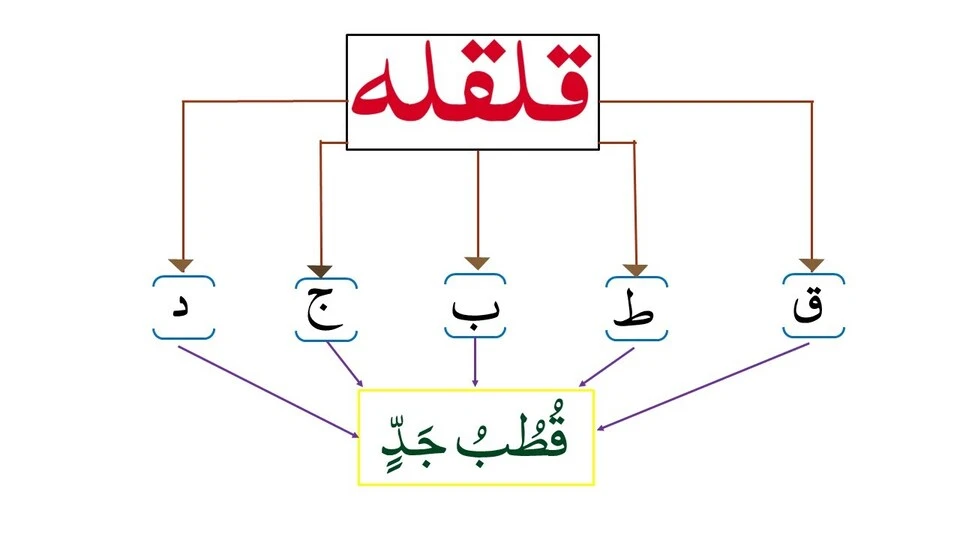
To define what is qalqalah in tajweed, it is important to know its letters. The Qalqalah letters, known as the Huruful Qalqalah in Arabic, are a set of five specific consonants that are pronounced with a distinct echoing sound when they appear with a sukoon (vowel-less state) in Quranic recitation and Arabic speech. These letters are: ق (Qaf), ط (Taa), ب (Baa), ج (Jim), and د (Dal). The phrase “قطب جد” (Qutb Jad) is often used to easily remember these letters.

There are two special characteristics associated with the Qalqalah letters to give them this unique sound: Jahr, which is blocking the smooth flow of air while pronouncing it, and Shiddah, which means blocking the flow of sound. The Qalqalah happens only in a sukoon state. This means that when one of these letters carries a vowel sign like Fatha, Kasra, Dhamma, or Tanween, it is pronounced usually without an echo-like vibration.

The main rules of qalqalah in Tajweed

1- For a letter to produce the Qalqalah sound, it must be one of the five designated Qalqalah letters: ق (Qaf), ط (Taa), ب (Baa), ج (Jim), or د (Dal).

2- The Qalqalah letter must be in a state of sukoon, meaning it is pronounced without any vowel markings. This can occur either in the middle of a word or at the end.

3- If a Qalqalah letter has a vowel sign such as Fatha, Kasra, Dhamma, or Tanween, it will not produce the characteristic echoing sound associated with Qalqalah; instead, it is pronounced normally.


Understanding and applying these rules is crucial for reciters to enhance the clarity and beauty of their recitation, ensuring that the unique qualities of Qalqalah are effectively conveyed.

What are the types of qalqalah in tajweed?

What are the types of qalqalah in tajweed?

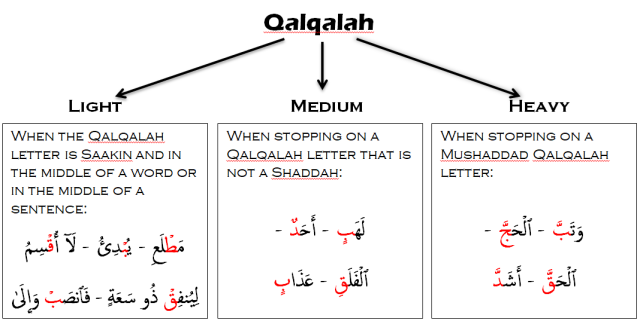
We have mainly two types of qalqalah in tajweed: qalqalah kubra, which means strong, and qalqalah sughra, which means weak. Some may add one between them as qalqalah wusta, which literally means medium or intermediate.

1- Qalqalah Kubra:

Qalqalah Kubra refers to the specific type of Qalqalah that occurs when a letter of Qalqalah is at the end of an ayah and is accompanied by a Shaddah. The last Harakah is dropped and the letter is pronounced with a greater echoing sound, enhancing the reverberation and clarity in recitation. This stronger form of Qalqalah makes the letter prominent and enhances its aesthetic value and rhythm of recitation.

2- Qalqalah sughra (weak):

Qalqalah Sughra is the weaker Qalqalah, which happens when the qalqalah letters appear in the middle of a word with a sukoon. In contrast to Qalqalah Kubra, which occurs at the end of an ayah and which is pronounced with a strong echoing sound, Qalqalah Sughra is a fine vibration. This weaker Qalqalah happens most of the time because of the swiftness in transitioning to the following letter, which makes the echoing relatively less prominent. While this does not have any extra stress, like its stronger sibling, Qalqalah Sughra it is important to master it if you are seeking fluency and accuracy in reciting the Holy Quran.

Some qalqalah examples from Quran

Some qalqalah examples from Quran

  • Qalqalah kubra examples
  • تَبَّتْ يَدَا أَبِي لَهَبٍ وَتَبَّ“
  • وَجَاءَتْ سَكْرَةُ الْمَوْتِ بِالْحَقِّ
  • بَلۡ كَذَّبُوا۟ بِٱلۡحَقِّ
  • وَٱلنَّخۡلَ بَاسِقَـٰتࣲ لَّهَا طَلۡعࣱ نَّضِیدࣱ


  • Qalqalah sughra examples
  • إِنَّكَ لَن تَسۡتَطِیعَ مَعِیَ (صَبۡرࣰا
  • سَأُنَبِّئُكَ بِتَأۡوِیلِ مَا لَمۡ تَسۡتَطِع عَّلَیۡهِ (صَبۡرًا
  • قَالَ ءَاتُونِیۤ أُفۡرِغۡ عَلَیۡهِ (قِطۡرࣰا
  • وَإِن كُنتُمْ فِي رَيْبٍ مِّمَّا نَزَّلْنَا عَلَى (عَبْدِنَا

How to practice qalqalah and other tajweed rules 

  • Start with the basics to be able to practice
  • Join an online tajweed course, a qualified teacher can provide valuable feedback and correct your mistakes.
  • Listen to a qualified sheik and start imitating.
  • Record yourself and compare it with reciters 
  • Try to extract ayat with qalqalah and its different types by yourself
  • Understand other tajweed rules (Non-sakinah, Meem sakinah, Madd,…)
  • Learn Maharaj, knowing where and how each letter is pronounced is crucial.
  • Practice regularly, and have a daily routine to practice tajweed rules.
  • Use different resources like books or online platforms.
  • Join a community group 
  • to meet other learners.

Noor Institute: best online platform for learning tajweed

Noor Institute is highly recognized as the best online place for learning Tajweed, having diversified and interactive online Quran classes that suit students’ needs at all levels. Their comprehensive Tajweed classes will cover matters relating to the accurate pronunciation and articulation of the letters in the Holy Quran, letting the learner have a strong base regarding the rules of its recitation. One can expect a nurturing environment for developing both confidence and skill from a team of seasoned instructors who understand the importance of personalized guidance. With the latest methods of teaching, Noor Institute facilitates enjoyment during learning, hence developing in every participant a further enriched understanding of the Quran while mastering the intricacies of Tajweed. Whether you’re a beginner or looking to refine your skills, Noor Institute is the ideal place for any person who wants more from his/her study of the Quran through quality online education.

Furthermore, Noor Institute offers you one of the best chances to experience its Tajweed classes with an absolutely free trial session. The prospective student will be exposed to interactive teaching, experienced methodologies, and a comprehensive curriculum in the person-to-person session.

By joining the free trial, you can take the first step towards a deeper understanding of the Quran and enhance your recitation skills in a supportive learning environment.

Find your ideal Tajweed mentor at Noor Institute.

If you are seeking to know what is qalqalah in tajweed and master the art of tajweed, Noor Institute is your ideal destination for mastering Tajweed and enhancing your Quran recitation skills. 

They offer an all-rounded, online Quran class for students at every level, from the very basics of Arabic phonetic learning to sophisticated techniques of Tajweed. Students study under experienced instructors who follow a well-structured course that emphasizes the intricacies of articulation, Hafs from the style of Asim’s recitation, and the spiritual essence of the Quran.

This interactive online platform is powered by a dynamic learning environment with small class sizes, offering each student personal attention and feedback. Students benefit from a wealth of resources, from video-recorded lectures and practice exercises to other tools and materials that further improve their learning conditions. With flexible scheduling, multilingual support, and competitive pricing, Noor Institute opens up top-notch Tajweed education to international students. This means that at the end, students are issued with a certificate of proficiency in Tajweed, thus enabling them to draw closer to the Holy Quran and to share their knowledge with others.

Take your initial step now and book your free trial to unlock the secrets of tajweed.

FAQ

  • What are the 5 Qalqalah letters?

Letters are: qaf (ق), taa (ط), baa (ب), Jeem (ج), Daal (د). To make memorizing easier, it has been known by the word qotb Jadd (قطب جد)


  • Which surah has a lot of Qalqalah kubra?

Surah Al-Ikhlas, Qalqalah el-kubra is applied at the end of every verse


  • Which surah has a lot of Qalqalah sughra?

Surah Al-Qalam, it has a fair number of qalqalah sughra

most important surah in the Quran

From Praise to Guidance: the most important surah in the Quran

At the heart of the Quran lies a surah of unparalleled significance, revered by Muslims worldwide for its profound teachings and timeless wisdom. This surah, known as the most important surah in the Quran and a cornerstone of Islamic faith and practice, encapsulates the essence of monotheism, guidance, and mercy. Its verses resonate with believers, offering relief, guidance, and inspiration in times of joy and adversity.

Surah Al-Fatiha. Known as ‘The Opening,’ it is the gateway to the Quran, representing its essence in just seven verses. It is a prayer for guidance, mercy, and a path to righteousness, recited in the daily prayers, a constant reminder of the bond between the Creator and His creation

Introduction to the surahs of the Quran

The Quran, the holy book of Islam, is divided into 114 chapters known as surahs, each surah varies in length, theme, and context, ranging from the foundational principles of Islamic belief and spirituality to guidelines for moral conduct and societal justice.

Each surah has its distinct characteristics, with some serving as the most important surah in the Quran and a cornerstone in daily prayers, such as Surah Al-Fatiha, which is fundamental in Islamic worship and consists of seven verses that praise and seek guidance from the Almighty

The surahs of the Quran serve as a deep and eternal wellspring of direction, knowledge, and inner illumination. They are further divided into verses, known as ayahs, which provide valuable insights into various aspects of guidance, faith, and patience, offering moral and ethical principles that should guide a Muslim’s life.

The surahs of the Quran cover various topics such as the significance of learning from history, maintaining faith during difficult times, women’s rights, marriage, divorce, inheritance, and the treatment of women. They also highlight the importance of fairness and compassion and offer guidance on how to face life’s challenges with faith, patience, and gratitude.

What is the most important surah in the Quran?

The greatest and the most important surah in the Quran is Al-Fatiha, often referred to as the Opening or the Opener. This distinction comes directly from a hadith where the Prophet Muhammad (peace be upon him) imparted its significance to his companion, Abu Sa’id bin Al-Mu’alla (may Allah be pleased with him). The Prophet said, “I will teach you the greatest surah in the Quran before you leave the mosque…” and then recited, “All praise is due to Allah, the Lord of all worlds,” which is the opening verse of Al-Fatiha. He further explained that this surah is referred to as the “seven oft-repeated verses” and the “Great Quran” which he has been given.

Al-Fatiha holds a unique position in Islamic worship and daily life. It is recited in every unit of the Muslim prayer (Salah), making it the most frequently recited part of the Quran.

The structure and content of Al-Fatiha are profoundly significant. The first three verses focus on Allah, His attributes, and His worship, while the remaining verses are a supplication from the worshipper seeking guidance, support, and protection from going astray. This dual structure signifies the relationship between the Creator and His creation, blending worship and supplication seamlessly.

Why Al-Fatiha is the most important surah in the Quran

Al-Fatiha is considered the most important surah in the Quran due to its profound significance in both recitation and meaning, establishing a deep connection between the worshipper and Allah. This surah reflects the essence of the entire Quran, encapsulating core themes such as praise to Allah, His mercy, sovereignty, guidance, and the Day of Judgment. It begins by praising Allah, recognizing His lordship and mercy, and then seeking His guidance on the straight path. The hadith about Al-Fatiha highlights its paramount importance and encourages believers to contemplate its meanings and incorporate its teachings into their lives. Al-Fatiha’s unique position in daily prayers and its comprehensive message make it an indispensable part of a Muslim’s spiritual life, embodying the fundamental principles of faith and devotion.
Important lessons from Surah al Fatiha

Surah Al-Fatiha, the most important surah in the Quran, contains several important lessons for believers that:

  1. The surah begins with expressing praise and gratitude to Allah, emphasizing the importance for believers to begin their prayers and supplications by acknowledging Allah’s sovereignty and blessings as the Lord of all worlds.

  2. It emphasizes essential attributes of Allah, particularly His mercy and lordship. By declaring “The Most Gracious, the Most Merciful,” it reminds believers of Allah’s compassionate nature and encourages them to seek His mercy and kindness.

  3. The surah emphasizes the Day of Judgment, serving as a reminder to believers about their responsibility and the ultimate return to Allah. This highlights the significance of living a virtuous life.

  4. The concept of Tawheed (monotheism) is emphasized in the verse ‘You alone we worship, and You alone we ask for help’, highlighting the importance of exclusive worship and dependence on Allah.

  5. “Guide us on the straight path” is a powerful supplication for divine direction. It instructs believers to continuously seek Allah’s guidance in their lives, asking to be led on the path of righteousness and steered away from misguidance.

  6. The last verses differentiate between those who have been blessed by Allah and those who have strayed or angered Him. This acts as a reminder to emulate the actions of the pious and steer clear of the routes that deviate from Allah’s blessings.

Noor Institute provides an online Quran tafseer course that works as a comprehensive manual for Muslims, encompassing vital aspects of faith, devotion, and behavior. 

Other significant surahs in the Quran

Firstly, it is important to highlight that all the Quran is important, and mentioning the most important surah in the Quran or other surahs doesn’t mean that those are only important. However, the importance of certain surahs in the Quran became evident when the Prophet Muhammad specifically mentioned them by name, highlighting their virtues and unique benefits for believers in this world and the hereafter. Among the surahs that the Prophet (peace be upon him) mentioned and explained their significance are those that provide numerous benefits to the faithful.

Here are some other significant surahs in the Quran:

  • Surah Al-Baqarah: the longest chapter in the Quran and discusses various subjects, providing extensive advice on individual behavior, familial affairs, and legal concepts.

  • Surah Yassin: often called the ‘Heart of the Quran,’ conveys a profound message regarding the strength and compassion of Allah, which deeply resonates with believers.

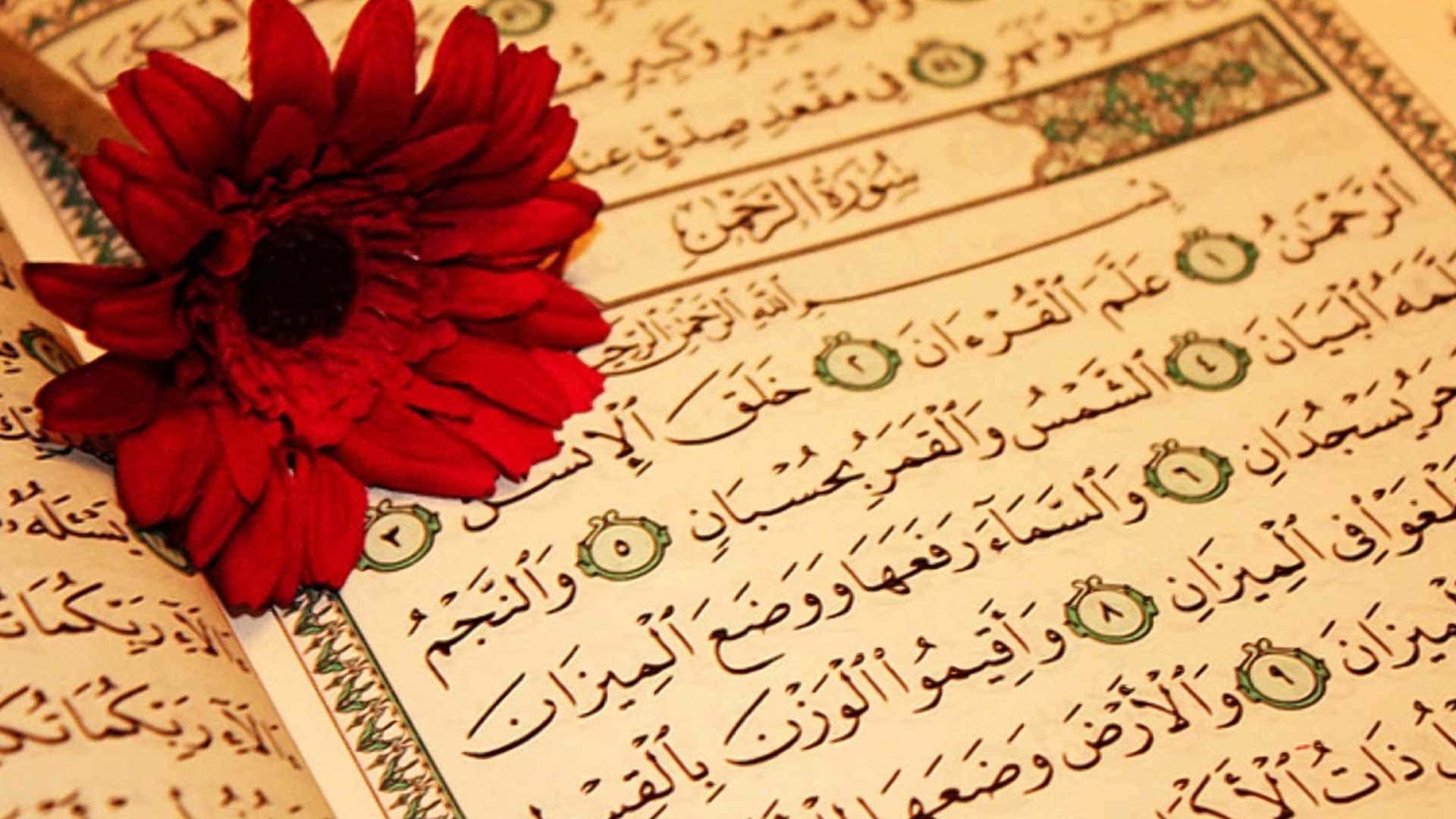
  • Surah Ar-Rahman: This chapter praises the numerous blessings and favors of Allah, urging believers to express gratitude for His kindness.

  • Surah Al-Mulk: highlights the grandeur of the Creator, prompting believers to reflect on the marvels of the universe and appreciate the beauty and intricacy of creation.

  • Surah Al-Ikhlas: renowned for its concise explanation of the monotheistic essence of Allah, serving as a significant affirmation of faith and a reminder of the unity of God.

  • Surah Al-Falaq and Surah An-Nas: also known as the surahs for seeking refuge, offer believers a feeling of security and spiritual strength by protecting against harm and negative influences.

  • Surah Al-Anfal: focuses on providing guidance on the principles of war and peace, highlighting the significance of justice, unity, and ethical behavior in all pursuits.

  • Surah Al-Kahf: the surah is filled with deep narratives that carry important teachings, urging believers to contemplate their own lives and find inspiration in the tales it presents.

Surahs that should be read before sleeping

In the prophetic Sunnah, Prophet Muhammad has clarified the most important surah in the Quran the hadith. Additionally, he advised a bedtime routine that provides protection from jinn and ensures that angels surround and safeguard you throughout the night. This routine includes specific supplications (athkar) and recitations from the Quran that fortify one’s faith and offer divine protection. Among the surahs recommended to be read before sleeping are Surah Al-Isra, Az-Zumar, As-Sajda, and Al-Mulk. These chapters carry profound meanings and invoke a sense of tranquility and reflection on the greatness of Allah. Additionally, Surah Al-Ikhlas, Al-Mu’awwidhatayn (which include Surah Al-Falaq and Surah An-Nas), and Surah Al-Kafirun are also included in this nightly practice. Surah Al-Ikhlas affirms the oneness of Allah, while Al-Mu’awwidhatayn are known as the chapters of seeking refuge, protecting the reader from all forms of harm. Surah Al-Kafirun, which emphasizes the rejection of disbelief and the affirmation of pure monotheism, is also part of this essential routine. By incorporating these surahs into the bedtime routine, one not only gains protection and peace but also strengthens their spiritual connection with Allah, ensuring a serene and blessed sleep.

Unlocking the Wisdom of Quarn Surahs with Noor Institute

Your pursuit of enlightenment is a delightful journey to illuminate your soul and mind with the profound wisdom embedded within the most important surah in the Quran and other Quran surahs, where you will delve deep into the meanings, historical contexts, and spiritual significance of each surah, provided with comprehensive insights that illuminate your faith and understanding.

Noor Institute offers a profound journey into the heart of Islamic teachings, providing an in-depth exploration of the causes of revelation for each surah. This approach enables students to gain a comprehensive understanding of Islam and its historical context. Participants explore essential branches of knowledge needed for deep interpretation of the Quran. They will learn Arabic vocabulary and apply the lessons of each surah to their lives. By walking in the footsteps of the Prophet Muhammad (PBUH) and discovering his character along with the stories of past prophets, students will find inspiration and guidance. 

The institute goes beyond mere translations, encouraging learners to delve into the original Arabic text to understand the verses in their intended context. Additionally, it explores the scientific marvels mentioned in the Quran, enriching students’ understanding of the harmony between faith and reason. By connecting each surah and its verses to other parts of the Quran and Hadith, Noor Institute builds a comprehensive and interconnected understanding of Islamic teachings.

Book your free trial now to unlock the treasures that have enlightened seekers for centuries, crafted beautifully.

Benefits of Surah al Rahman

The Bride of the Quran: Benefits of Surah al Rahman

Sometimes we take Allah’s blessings for granted and forget to express gratitude amidst the distractions of worldly life. However, out of His mercy, we have the presence of the Quran, which constantly reminds us of Allah’s blessings that we need to thank One of the benefits of surah al Rahman, known as the “Bride of the Quran,” is that it is one of the most virtuous chapters in the holy book that not only brings countless rewards but also serves as a constant reminder of Allah’s boundless blessings upon humanity.

By reflecting on the verses of Surah Al-Rahman, which emphasize the countless bounties bestowed upon us, we can rekindle our gratitude towards the Creator and recognize the innumerable blessings we have been granted. The surah’s ability to restore inner peace and strengthen our connection with Allah makes it a powerful tool for personal growth and spiritual fulfillment

Why should we recite the Quran?

Reciting the Quran is an act of profound spiritual significance that transcends mere reading. It is a deep engagement with the very words of Allah, a means to fill one’s life with divine wisdom and guidance. In a world where we often find ourselves rushing through life, the Quran serves as a refuge, a source of reassurance and comfort. The sentiment expressed in the saying, “I don’t remember ever loving anything in this life as much as I loved the reassurance you gave me by your presence,” resonates deeply with the experience of immersing oneself in the recitation of the Quran. It is a direct connection to the divine, a dialogue that enriches the soul, purifies the heart, and elevates the mind.

Moreover, the recitation of the Quran is not solely about personal enlightenment; it is also about preserving the integrity and purity of Islam, ensuring that its teachings are passed down through generations in their most authentic form. Engaging with the Quran through classes that facilitate hifz Quran online serves as a modern gateway to this sacred practice, offering individuals the opportunity to memorize and recite the Quran under the guidance of knowledgeable instructors. By engaging with the Quran in this way, individuals not only enrich their own lives but also contribute to the preservation and dissemination of Islamic principles for generations to come.

What are the benefits of surah al Rahman?

Surah Ar-Rahman is a chapter of the Quran that begins with one of the names of Allah without any preceding text. In this surah, the verse emphasizing gratitude and reverence to Allah is repeated thirty-one times.

The benefits of surah al Rahman are countless:

  1. The surah underscores Allah’s mercy and blessings. Its name, “Ar-Rahman,” derives from one of Allah’s names, the Most Merciful. It showcases the many blessings Allah has given to humanity, ranging from the sun and moon to the expansive oceans and diverse life forms. 
  2. Surah Al-Rahman reminds believers of God’s plentiful favors, instilling gratitude and encouraging them to be thankful and appreciative of what they have been given. 
  3. The surah emphasizes the importance of justice and balance in God’s creation, encouraging individuals to uphold justice and fairness in their interactions and relationships. 
  4. Reciting and memorizing Surah with sincerity can bring a feeling of calmness and alleviate stress and anxiety, providing spiritual comfort and peace. 
  5. It emphasizes the importance of being accountable for one’s actions the belief in the afterlife and the concept of the Day of Judgment, where individuals will be held responsible for their deeds. This serves as a motivation for believers to engage in righteous actions and make preparations for life after death.

benefits of surah al Rahman for specific needs

One of the other benefits of surah al Rahman is that reciting it holds profound significance in the lives of Muslims, offering a multitude of benefits that extend beyond mere recitation. While there is no specific hadith addressing the benefits of this Surah for marriage, it is believed that the act of reciting it with solid faith and a belief in Allah’s mercy can lead to the fulfillment of one’s desires. Similarly, for those seeking success and wealth, reciting Surah Ar-Rahman with a strong conviction in Allah’s ability to grant wishes can pave the way for achieving aspirations. Furthermore, the Surah is believed to have health benefits, serving as a source of protection, healing, and well-being when recited with sincerity and trust in Allah’s power. By engaging in the recitation of Surah Ar-Rahman with faith and devotion, individuals can tap into its spiritual blessings and experience the transformative impact of connecting with the divine through the verses of the Quran.

What are the topics included in the surah?

  1. The beginning with praise for Allah Almighty and gratitude for His creation through the teaching of the Quran. 
  2. Illustrating an aspect of Allah’s power and His blessings upon His creation. 
  3. Highlighting the temporary existence of all living beings on Earth and emphasizing that only Allah is eternal. 
  4. Challenging jinn and humans to penetrate the realms of the heavens and the Earth. 
  5. Explanation of the horrors of the Day of Judgment, the dire consequences for the deniers, and the blissful outcome for the believers; and describing what Allah has prepared for them of delights. 
  6. The surah concludes with exaltation and praise for Allah.


When understanding the topics included, we will have a deep connection with the countless benefits of surah al Rahman

Objectives of Surah al-Rahman 

Surah Ar-Rahman’s themes encompass a multitude of objectives, including highlighting the significance of its name; “Ar-Rahman,” which signifies the all-encompassing mercy and generosity of Allah towards His creations. This fosters a sense of yearning for His blessings, fear of His retribution, and acknowledgment of His constant generosity. 

  1. The Surah emphasizes the greatest blessing given by Allah to humanity, which is the gift of religion, starting with the revelation and teaching of the Holy Quran. It further delves into the creation of humans and their distinction through intellect as a result of this divine guidance. 
  2. Surah Ar-Rahman beautifully weaves together a depiction of Allah’s abundant blessings upon humanity with His unmatched power, mastery, and precision in creation. It delves into the creation of Jinn, clarifies the concept of divine justice, and outlines the ultimate reward awaiting the righteous in paradise, and the punishment awaiting the disbelievers. The surah emphasizes Allah’s favors upon humankind, particularly highlighting the gifts of intellect and knowledge. This profound connection underscores the inherent benefits of surah al Rahman, a continuous reminder to express gratitude to Allah for His blessings. It also describes paradise with intricate details, illustrating two distinct levels within it to correspond with the elevated faith of believers. It emphasizes that Allah alone is the eternal, majestic, and generous Being, while everything on Earth is transient and subject to decay. The Surah explains that all beings in the heavens and on Earth turn to Allah in seeking their needs, with Allah managing numerous affairs in His creation daily. 
  3. Surah Ar-Rahman portrays the scene of accountability on the Day of Judgment, emphasizing that ultimate judgment rests solely in the hands of Allah. He is the sole King and Judge, and no one can escape His punishment, as all authority lies with Him in that event. The Surah warns of accountability, where individuals will be judged based on their deeds, concluding with praise and glorification of Allah, the Owner of Majesty and Honor.

Quarn recitation classes with Noor Institute 

After learning about the benefits of surah al Rahman and its key themes, I’m sure you’re interested in incorporating it into your daily routine However, it’s crucial to ensure that you recite it correctly. That’s where Noor Institute’s Quran recitation classes come in.

Noor Institute offers transformative online Quran recitation classes tailored to individual needs. Their expert instructors focus on proper pronunciation, articulation of letters, and Tajweed rules to help students recite the Quran with confidence and accuracy.

The courses provide a nurturing environment for students to practice reciting passages from the Quran, allowing them to become more comfortable with the text and establish a natural flow in their recitation. Instructors are adept at identifying and correcting pronunciation mistakes, ensuring that students build a solid foundation for Quranic recitation

Noor Institute’s online classes offer unmatched convenience and flexibility, enabling students to learn from the comfort of their own homes at their own pace. With personalized learning plans, interactive tools, and one-on-one attention, Noor Institute is dedicated to helping students master the art of Quranic recitation and develop a deeper connection with the holy book

Elevate Your Recitation with Noor Institute’s Expert-Led Online Quran Classes. Enroll Now and Recite with Confidence!

Frequently asked questions 

  • What are the blessings mentioned in the Surah?

Among the many blessings Allah gave us, Surah Rahman highlights ten significant ones. These include the ability to speak and express ourselves, the guidance of the holy Quran, the movement of the sun and moon that ensures life on Earth, food as a necessity, the sea and ocean that facilitate travel and fishing, Iman (faith) that helps us understand life as a test, the knowledge of the Day of Judgment that encourages us to fear Allah and obey Him, Heaven as a reward for believers, Hell as a punishment for disbelievers, and obeying Prophet Muhammad as a blessing.

Mentioning these blessings is one of the various benefits of surah al Rahman because it reminds us to thank Allah constantly

  • When to read Surah al-Rahman?

There is no mention in the Quran or the authentic Sunnah regarding the specific time preferred for reciting Surah Rahman. In Islam, it is commendable to read the Quran during both day and night, and Muslims can do so at any time. However, it is recommended to recite the Quran at night as this time holds great virtue and reward, as stated in both the Quran and Sunnah.

  • What was the reason for the revelation of Surah al-Rahman?

Surah Rahman was revealed to the prophet while he was residing in Mecca during the initial stages of revelation. Its purpose was to highlight the numerous blessings given to us by Allah, which are undeniable.

  • Why Surah al-Rahman is called the bride of the Quran?

One of the reasons it was thought to be called by that name is due to its focus on the rewards that believers will receive in paradise.

  • What will happen if I read Surah al-Rahman every day?

It is believed that one of the benefits of surah al Rahman is that reciting the surah daily will offer protection and healing to the reciter, and it is also thought to aid in resolving specific issues or answering prayers.

learn quranic arabic online free

Master the Quran for Free: Dive into Online Learning Today!

Ever felt a yearning to truly connect with the divine beauty of the Quran, not just in translation but in its original Arabic? The language itself, blessed by its chosen role as the vessel of revelation, holds an undeniable allure for those seeking a deeper understanding of Islam. The good news is that learn Quranic Arabic online free is now more accessible than ever!

Depending on the student’s proficiency, there are various levels in the Quranic Arabic classes. Non-Arabic speakers should, for instance, understand the Arabic alphabet and how to pronounce it at a basic level.

So, whether you’re a complete beginner or seeking to refine your existing knowledge, join us as we discover the joy of mastering Quranic Arabic, one step at a time, in the comfort of your own home.

What is the meaning of Quranic Arabic?

The eloquence and refinement of the lexicon and linguistic idioms found in the Holy Qur’an have endured over time. It has provided linguists with a wealth of vocabulary and grammatical rules that they have utilized as references in linguistic conundrums.

The beauty of the meanings and the exact descriptions found in the Holy Qur’an are still being studied by linguists today.

The Qur’an was written in several scripts throughout history, mostly in the Kufic script, from the first to the fifth centuries. 

Arabic scripts became increasingly varied by the eighth or ninth century, and the Qur’an was written in the Thuluth script. The most elegant script to have ever existed is the Naskh script, which was developed in our day and is now widely used to write the Qur’an.

Seeking to learn Quranic Arabic online free that truly meets your needs? Look no further than Noor Institute! We offer tailored courses for beginners and experts alike, crafted to unleash your potential for understanding and appreciating the Quran.

Benefits of learning Quranic Arabic for complete beginners

Engaging in religious ceremonies

Whatever the language, the Holy Quran must be recited in Arabic during Muslim prayers. This highlights how important it is for Muslims to acquire Arabic to fully participate in their religious practices.

Correct understanding of the Qur’an

Gaining a thorough comprehension of the Holy Qur’an requires learning Qur’anic Arabic. The depths of the Qur’anic meanings may be difficult to completely understand and appreciate if one does not have a firm command of the Arabic language and its linguistic expressions.
The Arabic language is how people decipher God’s purposes and messages contained in the Qur’an.

A Legacy from the Prophet’s Companions

The Companions and more seasoned Muslims stressed the value of studying Arabic. God bless Umar ibn al-Khattab, who advocated studying Arabic as a necessary language for practicing one’s religion. Gaining proficiency in Arabic helps Muslims fulfill their religious duties and connect with their faith on a deeper level.

Interpretation of the Quran

If you learn Quranic Arabic online free, you will have a deep understanding of the Arabic language, which is extremely important when it comes to interpreting the Holy Qur’an. As the Qur’an was revealed in Arabic, it is essential to comprehend and interpret it using the same language in which it was given to the Prophet Muhammad, peace be upon him. Scholars have stressed the importance of Arabic in understanding and explaining the Qur’an, warning against interpreting the Book of God without a solid grasp of the Arabic language.

Spreading Islamic culture

By becoming proficient in the Arabic language of the Quran, Muslims can acquire a comprehensive and precise comprehension of their faith. This comprehension empowers them to effectively communicate their knowledge and Islamic heritage to others. Through their fluency in Arabic, individuals can articulate the fundamental principles of Islam, spread their beliefs, and actively participate in the propagation of Islamic teachings.

Understanding the rulings of Islam

Learning Arabic allows Muslims to reach the origin of their faith’s writings. The Qur’an and the esteemed Sunnah form the base of Islam, including its laws and traditions, and both are in Arabic. Knowing Arabic lets people delve into and understand the religion’s rules, which guide their rituals. This lets them more accurately and insightfully meet their religious duties.

How do I learn Quranic Arabic online free?

Poetry

Poetry has always been a cherished art form, and Arabic poetry holds a special place in the hearts of many. It’s not just about stringing words together; it’s a masterful display of linguistic acrobatics, weaving vivid imagery and profound emotions into verses that resonate with the soul. However, not all poems are created equal.

That’s where the rich tapestry of Arabic poetic genres comes in. Dive into the world of prison poetry, where verses penned behind bars pulsate with raw emotion and unflinching honesty. Explore the profound meditations of pre-Islamic poetry, etched on the sacred curtains of the Kaaba. Savor the eloquent sonnets of Ahmed Shawky, a towering figure of 20th-century Arabic literature.

Dictionaries and Glossaries

Using dictionaries can greatly assist you in learning terminology and meanings that are unfamiliar to you. The Academy of the Arabic Language’s intermediate dictionary, known as al mujam al waist, is one of the dictionaries that can assist you. It stands out for having a well-organized layout and a wide vocabulary.

Learn Quranic Arabic online free at Noor.

Noor Institute is a gateway to a deeper comprehension of your faith; it’s more than just an academic school. Here, you’ll explore the online arabic language classes in usa, discover the hidden treasures of the Quran, and enjoy its exquisite language while learning priceless lessons.

Quranic Arabic books

Holy Quran

The primary source for learning Quranic Arabic online for free is the Holy Quran itself!

Numerous copies are available, featuring stunning calligraphy, translations, and commentary to help you understand.

Tajwid literature

These go deeply into the guidelines for reciting the Quran, assisting you in learning the correct pronunciation and intonation.

Hafs Qari’s translation

can learn the subtleties of this particular recitation style by reading books that are devoted to it, as it is frequently employed.

Tafsir books

For anyone seeking to learn Quranic Arabic online at no cost, there’s no better resource than the scholarly Tafsir books. These volumes are authored by experts who have meticulously crafted detailed commentaries on the Quran, providing valuable insights into its historical context, interpretations of verses, and explanations of intricate concepts.

Quranic studies books

These explore various aspects of the Quran, such as its literary style, thematic coherence, and relationship to other religious texts.

Classical Arabic literature

Studying works like poetry and prose from the golden age of Arabic literature can further enrich your understanding of the language and its cultural context.

The best online Quranic Arabic course

Noor Institute offers you best-in-class online Quranic Arabic courses, designed to nurture your fluency and understanding in a supportive and inclusive environment.

  • Expert instructors, passionate about the language and faith, guide you with patience and expertise.
  • Tailored learning paths cater to your individual needs and pace, ensuring comfortable progress.
  • Interactive lessons bring the Quran to life, where you explore the richness of vocabulary and unveil the power of each verse.
  • Advanced technology offers a seamless learning experience, whether you’re at home or on the go.
  • A vibrant community connects you with fellow learners from diverse backgrounds, fostering support and shared growth.

Noor Institute goes beyond textbook learning. We provide holistic immersion in Arabic Letters with Tajweed course, integrating cultural insights and spiritual understanding into every step of your journey. 

In conclusion, if you learn Quranic Arabic online free, you’ll enrich your life and deepen your connection with the Quran.

Explore a world of possibilities with diverse online resources. Discover beginner-friendly courses to take your first steps, or delve deeper with advanced learning materials. Dive into the beauty of the Quran’s original language at your own pace and find the perfect fit for your journey.

Ready to unlock the magic of Quranic Arabic? Visit Noor Institute today and discover how our engaging online courses can empower you to connect with the Quran on a deeper level.

FAQ

Can I learn Arabic online for free?

– Absolutely! Dive into the world of Arabic with a wealth of free online resources, from interactive courses to engaging podcasts and cultural insights.

Is Quranic Arabic different from normal Arabic?

– Yes, while sharing the core of everyday Arabic, Quranic Arabic incorporates unique vocabulary and pronunciation styles specifically optimized for the beauty and clarity of reciting the Quran.

online Islamic courses for beginners

Start your online Islamic courses for beginners

Do you yearn to deepen your understanding of Islam? Are you looking for online Islamic courses for beginners? You may be a complete beginner or someone seeking to deepen their understanding. The Noor Institute welcomes you with open arms, ready to illuminate your path with knowledge and understanding.

At Noor Institute, we believe that learning Islam is not just an academic pursuit but a transformative experience that nourishes your soul and guides you towards a fulfilling life.

We offer a comprehensive curriculum covering all aspects of Islamic studies, from the Quran and Sunnah to Islamic history and contemporary issues.

Are you willing to start over and learn Islam from the ground up?
Now let’s get started by discussing where to look for curricula and classes at the beginner level.

The importance of online Islamic courses for beginners

For many beginners, online Islamic courses can be a transformative gateway to understanding and practicing their faith. Gone are the days when seeking Islamic knowledge meant solely attending physical classes or relying on limited resources. The internet has revolutionized learning, making Islamic education accessible to anyone, anywhere, at any time.

It takes knowledge to understand Islam, and every Muslim must do so. As a Muslim, you have probably had occasions in the past when acquaintances or non-Muslim friends of yours wanted to know more about Islam. In a few of these situations, you might have discovered that you were unable to adequately describe Islam to your friend who is not Muslim or the reasons behind your faith. Have you ever found yourself in this situation before, feeling let down by your poor ability to explain Islam?

Knowing the essentials of Islam, including its foundations, history, and the most significant passages from the holy Quran, as well as the idea of an afterlife and the significance of loving and knowing the Prophet Muhammad, peace and blessings be upon him, are all crucial components of Islamic knowledge that will help you learn about Islam and better explain it to others.

Where to Begin Courses and Curriculum at the Beginner Level?

Online learning is a great deal

The internet is a veritable gold mine of information, with a wide selection of online Islamic courses for beginners designed especially for them. These courses provide you with a strong basis for your spiritual development, covering everything from the principles of prayer to basic Islamic beliefs.

Trusted Islamic Websites and Apps

These are your go-to friends when it comes to locating trustworthy resources. Look for platforms that provide in-depth courses on a variety of Islamic topics, including hadiths, fiqh (Islamic law), the Quran, and more.

Noor Institute

Noor Institute believes that your journey of Islamic learning is unique and personal. Noor supports you every step of the way, providing the guidance and resources you need to illuminate your path and discover the transformative power of faith.

Why choose Noor for online Islamic courses for beginners?

Experienced and passionate instructors

Our team of knowledgeable and enthusiastic professors is something we are proud of at Noor Institute. In addition to being authoritative in their domains, they are devoted mentors who recognize the need to provide students with kind and understanding guidance. Our teachers are dedicated to fostering a nurturing learning atmosphere where you can advance both intellectually and personally. They guarantee that you get the greatest education possible by being accessible at all times to respond to your inquiries, offer advice, and impart their vast experience.

Tailored online Islamic courses for beginners

Every student has different needs and interests, and we recognize this. To meet your unique needs, we at Noor Institute provide a broad selection of courses and programs. We offer alternatives to meet your needs, whether you’re looking for intensive learning to pursue long-term study programs, immersive retreats to expand your understanding, or short courses to improve your abilities. With our adaptable approach, you can create a learning path that best suits your objectives and maximizes the benefits of your educational experience.

Welcoming and supportive community

You join a kind and encouraging community when you join the Noor Institute. Our goal is to provide a welcoming and inclusive atmosphere where people of all backgrounds may join together to grow and learn. The values of cooperation, tolerance, and respect form the foundation of our community. Through networking with people who share your interests and values, you will have the chance to form enduring relationships and build a support system that goes beyond your stay at the institution.

A comprehensive approach to education

Noor Institute’s curriculum extends beyond what can be found in textbooks. We support an all-encompassing educational strategy that incorporates Islamic principles into day-to-day activities. We give you the resources and direction you need to put your newly acquired knowledge to good use. In addition to academic disciplines, our curriculum emphasizes character development, spiritual growth, and practical skills. Our goal is to develop well-rounded people who can positively influence both their communities and the larger globe by fusing Islamic values with traditional education.

What Will You Learn Through Online Islamic Courses for Beginners?

1. The Islamic five pillars

The Shahadah

You could think of the Shahadah as the gateway to Islam. A person is considered a Muslim if they recite the Shahadah with awareness: “There is no god but Allah, and Muhammad is His Messenger.” It embodies surrender to the Oneness of Allah and recognition of Prophet Muhammad’s guidance.

Prayer

Prayer, or Salat, is the physical manifestation of faith, performed five times a day at set intervals. It’s direct communication with Allah, a moment of devotion and mindfulness amidst daily routines. Through Salat, Muslims express gratitude, seek guidance, and strengthen their connection with the Divine.

Fasting (Sawm)

Muslims fast from dawn to sunset throughout the holy month of Ramadan and refrain from eating, drinking, and having sex. This self-imposed fasting promotes self-control, compassion for the less fortunate, and spiritual cleansing. Sawm also fortifies one’s commitment and resolve, serving as a reminder of the significance of spiritual requirements over worldly ones.

Zakat

Zakat is the obligatory annual donation made to help those in need. It’s a form of social justice that ensures the well-being of the community and fosters compassion. By giving Zakat, Muslims purify their wealth, express gratitude for their blessings, and contribute to a more equitable society.

Hajj (Pilgrimage)

Every able-bodied Muslim who can afford it is obligated to perform Hajj at least once in their lifetime. This journey to Mecca unites Muslims of diverse backgrounds in a shared act of devotion, fostering unity and spiritual purification.

2- Fiqh

Fiqh delves into the practical aspects of worship, outlining the proper ways to perform acts like prayer, fasting, and zakat. This knowledge isn’t confined to mere rituals; it equips individuals with the tools to navigate everyday situations with Islamic principles in mind. Fiqh clarifies what constitutes halal (permissible) and haram (prohibited), empowering Muslims to make informed choices that align with their faith.

3- Sirrah

Sirah embarks on a captivating journey through the life of Prophet Muhammad (peace be upon him). It paints a vivid picture of his character, his struggles, and his triumphs. Students immerse themselves in the Prophet’s interactions with family, friends, and adversaries, observing how he navigated complex situations with unwavering faith and wisdom. Each episode of the Sira becomes a potent lesson, offering guidance on dealing with life’s challenges and cultivating virtues like patience, compassion, and courage. The Prophet’s life becomes a luminous beacon, illuminating the path for Muslims to emulate his exemplary conduct.

4- Hadith

Hadith serves as a precious treasure trove of the Prophet’s sayings and actions. Through the meticulous transmissions of their companions, Muslims gain access to a vast repository of wisdom and teachings. Hadith encompasses a spectrum of topics, from matters of worship and daily life to profound pronouncements about the future and insights into past civilizations. Studying Hadith allows Muslims to connect directly with the Prophet’s voice, imbibing his teachings and strengthening their faith. It fosters a deeper understanding of Islam’s core principles and equips individuals to apply them in their daily lives.

Free online Islamic courses for beginners 

Noor Institute offers you a free trial. Learn Islam online in USA which invites you to wander through the world of Islamic learning, sampling the flavors of Islamic wisdom. Listen to inspiring lectures by renowned scholars or join interactive discussions with fellow learners. The possibilities are endless!

With its user-friendly platform and flexible scheduling, Noor Institute makes learning accessible and enjoyable.

In conclusion, with dedication and the right resources, online Islamic courses for beginners can be an invaluable tool for them to embark on a fulfilling journey of faith and knowledge. So, take the first step today and open the door to a deeper understanding of Islam!

FAQ

What is the beginner course in Islam?

– The beginner course in Islam typically covers the core beliefs, the pillars of faith, basic prayers, and the life of Prophet Muhammad (peace be upon him).

learning Islam for new converts

Beginner’s Guide to learning Islam for new converts

As a new convert, seeking to find resources about learning Islam for new converts, trying to deepen your understanding of Islam, navigating the vast array of available resources can indeed feel overwhelming. From books and online articles to lectures and community gatherings, there are countless avenues through which one can explore the teachings and practices of the faith. However, amidst this plenty of information, it’s essential to find reliable, accessible resources tailored specifically to the needs and questions of new converts. You need to learn about the pillars of Islam, gain insights into Prophet Muhammad’s life and teachings, and seek practical guidance for incorporating Islamic principles into your daily life. Accordingly, finding the right resources can greatly facilitate your journey of faith. 

In this pursuit, it’s crucial to prioritize resources that provide clear explanations, authentic interpretations, and support networks to guide you through this transformative process. This introductory paragraph aims to acknowledge the potential challenges new converts may face in navigating the journey while emphasizing the importance of seeking out reliable and tailored materials to facilitate learning and growth in Islam.

Useful advice for learning Islam for new converts

If you are a new convert who is seeking to learn about Islam, this is for you:

  • Don’t rush: the most important advice in your journey of learning Islam for new converts is to take things slowly and not try to learn everything at once. As one convert be aware that your Islam should be like a ladder. Climb it one step at a time. Implement changes gradually in your lifestyle. There’s no need to ask complex questions before understanding the basics
  • Listen to stories of other converts: this will help you to navigate any complexities you may face at the beginning and feel that you are not alone
  • Focus on the Essentials: in the beginning, focus on learning the essentials and developing a relationship with Allah. Avoid getting deep into complex issues of Islamic law until you have a firm grasp of the basics.
  • Be patient: Remember that your faith will have ups and downs, and that’s normal for all Muslims. Be kind and patient with yourself as you navigate the challenges of being a new Muslim.

Basic introduction to Islam

When beginning the journey of learning Islam for new converts, it’s essential to start with a foundational understanding of the religion. At its core, Islam is built upon five fundamental beliefs, known as the Five Pillars of Islam. These pillars include the declaration of faith (Shahada), prayer (Salat), almsgiving (Zakat), fasting during the month of Ramadan (Sawm), and pilgrimage to Mecca (Hajj) for those who are able. Central to Islam is the reverence for Prophet Muhammad (peace be upon him) and his teachings, which serve as a guiding light for Muslims worldwide.
 Learning about Prophet Muhammad’s life, character, and mission is integral to understanding the principles and values of Islam. Additionally, gaining insight into Islamic rituals and practices, such as daily prayers, charity, and fasting, helps new converts immerse themselves in the faith’s rich traditions and customs. Moreover, familiarizing oneself with Islamic holidays and celebrations, such as Eid al-Fitr and Eid al-Adha, provides a deeper appreciation for the spiritual significance and communal aspect of Islamic life. 

By grasping these foundational elements of Islam, new converts can embark on a fulfilling journey of spiritual growth and discovery within the Muslim faith.

Understanding the Quran

In the journey of learning Islam for new converts, understanding the Quran holds paramount importance. The Quran, the holy book of Islam, serves as the ultimate source of guidance and inspiration for Muslims worldwide. Its teachings revealed to Prophet Muhammad (peace be upon him) over 23 years, include a comprehensive guide to life, covering matters of faith, morality, law, and spirituality. Structured into chapters, or Surahs, the Quran is organized in a manner that facilitates both recitation and reflection. Each Surah carries its unique message, themes, and lessons, contributing to the Quran’s rich source of guidance.

Interpretation and understanding of the Quran require careful study and reflection, often online Islamic courses guided by scholars, and commentators who provide insights into its meanings and contexts. For new converts, embarking on the journey of studying and memorizing the Quran can be a deeply enriching experience, fostering a deeper connection with the divine message and enhancing spiritual growth. Furthermore, applying the teachings of the Quran in daily life is integral to living a life aligned with Islamic principles and values. By incorporating the Quran’s teachings into everyday actions and decisions, new converts can strive to lead a life that reflects the values of faith, compassion, and righteousness elucidated in the holy text.

Practical Guidance for learning Islam for new converts

As a new convert, navigating through learning Islam involves several key steps to facilitate a smooth transition and deeper understanding of the faith as follows:

1- Begin your journey by learning about the basic core beliefs and principles of Islam, and understand the fundamentals of the faith.

2- connect with the local Muslim community, and participate in activities at mosques, Islamic centers, and community events. It is also beneficial to seek guidance and support from knowledgeable individuals = who can offer mentorship and address any inquiries you may have.

3- Start engaging in the daily prayers (Salat) and establish a consistent prayer schedule. Familiarize yourself with the correct procedure for performing Wudu and the positions of prayer. 

4- Continuously seek knowledge and education about Islam through various resources such as books, online Islamic courses, lectures, and seminars. Take advantage of reputable Islamic websites such as Noor Institute.

5- Make an effort to demonstrate Islamic values and principles through your daily actions and choices. Show kindness, honesty, compassion, and generosity when dealing with others, and aim to lead a life that aligns with Islamic teachings.

Navigating challenges with Noor Institute classes

Navigating the complexities of learning Islam for new converts can be challenging, but with the support of reputable platforms like Noor Institute, overcoming these obstacles becomes achievable. Noor Institute offers a comprehensive approach to learning about Islam, making the journey easier and more accessible. Through their courses, students explore fundamental aspects such as fiqh (jurisprudence), seerah (biography of Prophet Muhammad), and hadith (sayings of the Prophet), along with exploring Islamic history and culture.

One of the key strengths of Noor Institute lies in its experienced teachers, who are qualified Arabic native speakers. These dedicated instructors provide personalized 1-on-1 classes tailored to the individual needs and learning styles of each student. Additionally, Noor Institute ensures continuous progress through monthly evaluations sent to students and daily follow-up emails after each class, which include homework assignments. With these resources and support systems in place, you can embark on your journey of learning Islam with confidence and guidance from knowledgeable educators.

Frequently asked questions 

How to practice Islam for beginners?

 Start by learning the basics gradually and prioritizing key knowledge and practices. Engage with Islamic teachings through reading the Quran, learning about the life of Prophet Muhammad, and participating in Islamic rituals. Seek guidance from Islamic, teachers to deepen your understanding of Islam.

How should new converts approach the process of learning Arabic for prayers?

They should approach the process of learning Arabic for prayers gradually and organically, gradually incorporating Arabic words and phrases into their prayers to navigate the learning process effectively.

What are some challenges in learning Islam for new converts?

New converts to Islam often face challenges in learning the religion, including understanding Islamic practices and Arabic terms, feeling isolated without a support network, struggling to integrate culturally, dealing with stereotypes and misconceptions, and adjusting to lifestyle changes like dietary restrictions and dress codes.

the most beautiful names of Allah

Journey into the significance of the most beautiful names of Allah

The most beautiful names of Allah are fundamental in the Islamic creed, as they are the essence, foundation, and goal of faith. The more a servant knows about the names and attributes of Allah, the stronger their faith becomes, and their certainty and knowledge of Allah and His attributes are elevated. Knowledge of Allah, his names, and his attributes is the most noble knowledge among Muslims and the most honorable of all.

These names, resonating throughout the universe, are more than just words. They serve as portals to the limitless, beckoning your soul to embark on a profound voyage of exploration and wonder. Each name encompasses an entire cosmos, providing solace, resilience, enlightenment, and empathy in their most pristine essence.

Understanding the concept of Allah’s names

The most beautiful names of Allah or 99 Names of Allah, also known as the Supreme Names of Allah, are a collection of names that signify Allah’s perfect attributes and qualities, as well as the attributes of His majesty. These names represent Allah’s wisdom, mercy, generosity, and justice. They are a way of invoking Allah and expressing praise and admiration. The names are considered to be beautiful and demonstrate gratitude, glorification, and magnification of Allah.

Allah named himself with these names in his books or through the tongues of his messengers, or he kept them exclusive to His knowledge of the unseen. No one resembles or is similar to Him in these names. They are beautiful names intended to encapsulate the perfection of Allah’s attributes. Only Allah knows them fully and comprehensively.

Allah praised Himself with these names in the Quran, as He said: “Allah! There is no deity except Him. To Him belong the best names.” (Surah Taha, 20:8). The Prophet Muhammad (peace be upon him) encouraged their invocation by saying, “Indeed, Allah has ninety-nine names. Whoever memorizes them will enter Paradise.”

Incorporating the names of Allah into daily life

Incorporating the most beautiful names of Allah into daily life is a fundamental aspect of Islamic practice, deeply rooted in the Quran. The Quran, the holy book of Islam, contains numerous references to the names and attributes of Allah, emphasizing His mercy, compassion, and wisdom. By invoking these names in daily activities, Muslims seek to cultivate a profound connection with the divine and align their actions with the teachings of Islam. Whether through reciting specific prayers, reflecting on the meanings of Allah’s names, or embodying these qualities in interactions with others, integrating the names of Allah into daily life serves as a spiritual guide, fostering mindfulness, gratitude, and a sense of purpose in every moment.

Benefits of reciting the names of Allah

Reciting the most beautiful names of Allah offers numerous spiritual, psychological, and physical benefits.

 Reciting the names of Allah holds profound spiritual benefits that resonate through healing, protection, mindfulness, and divine connection. Through the recitation of Allah’s names, individuals seek relief and healing, finding protection from harm and ailments. This practice not only fosters physical well-being but also enhances mindfulness and presence with Allah, guiding individuals toward a deeper spiritual connection. Moreover, reciting these names serves as a means to seek forgiveness, blessings, and divine guidance, allowing believers to navigate life’s challenges with a sense of peace and clarity. Ultimately, the recitation of Allah’s names is a transformative practice that enriches the soul, nurtures the spirit, and aligns individuals with the divine attributes of mercy, compassion, and wisdom encapsulated in each name.

Strengthening your faith with Noor Institute 

Strengthening faith through the Quran and the recitation of Allah’s names is a cornerstone of Islamic practice, fostering a deep spiritual connection and enhancing one’s understanding of the divine. Engaging with the Quran, the literal word of Allah provides profound insights, guidance, and quietness for believers. Reciting the most beautiful names of Allah creates a sense of worship and respect, reminding individuals of His attributes and mercy. 

Noor Institute Quran classes offer a comprehensive approach to deepening this connection and strengthening faith. Through structured programs encompassing recitation, memorization, tafsir, and tajweed (Quran recitation rules), students are guided on a transformative journey through the Quran. Recitation classes enable students to develop fluency in reading the Quran, while memorization fosters a personal relationship with its verses. In-depth tafsir classes reveal the layers of meaning within Quran text, enriching understanding and spiritual insight. Additionally, tajweed instruction ensures the accurate and melodious recitation of Quran verses. By immersing oneself in the teachings of the Quran and the most beautiful names of Allah through Noor Institute Quran classes, individuals can embark on a path of spiritual growth, enlightenment, and solid faith.

The 100 names of Allah

“The Most Beautiful Names belong to Allah, so call on Him by them”

The most beautiful names of Allah are 100, starting with he is Allah then his 99 names which are:

Arabic Name

Transliteration Meaning
الرحمن Ar-Rahman The Most Gracious
الرحيم Ar-Rahim The Most Merciful
الملك Al-Malik The Sovereign
القدوس Al-Quddus The Holy
السلام As-Salam The Source of Peace
المؤمن Al-Mu’min The Bestower of Faith
المهيمن Al-Muhaymin The Guardian
العزيز Al-Aziz The Almighty
الجبار Al-Jabbar The Compeller
المتكبر Al-Mutakabbir The Majestic
الخالق Al-Khaliq The Creator
البارئ Al-Bari’ The Evolver
المصور Al-Musawwir The Fashioner
الغفار Al-Ghaffar The Forgiver
القهار Al-Qahhar The Subduer
الوهاب Al-Wahhab The Bestower
الرزاق Ar-Razzaq The Provider
الفتاح Al-Fattah The Opener
العليم Al-Alim The All-Knowing
القابض Al-Qabid The Constrictor
الباسط Al-Basit The Expander
الخافض Al-Khafid The Abaser
الرافع Ar-Rafi’ The Exalter
المعز Al-Mu’izz The Bestower of Honour
المذل Al-Mudhill The Humiliator
السميع As-Sami’ The All-Hearing
البصير Al-Basir The All-Seeing
الحكم Al-Hakam The Judge
العدل Al-Adl The Just
اللطيف Al-Latif The Subtle
الخبير Al-Khabir The All-Aware
الحليم Al-Halim The Forbearing
العظيم Al-Azim The Magnificent
الغفور Al-Ghafur The Forgiving
الشكور Ash-Shakur The Appreciative
العلي Al-Ali The Most High
الكبير Al-Kabir The Greatest
الحفيظ Al-Hafiz The Preserver
المقيت Al-Muqit The Nourisher
الحسيب Al-Hasib The Reckoner
الجليل Al-Jalil The Majestic
الكريم Al-Karim The Generous
الرقيب Ar-Raqib The Watchful
المجيب Al-Mujib The Responsive
الواسع Al-Wasi’ The Vast
الحكيم Al-Hakim The Wise
الودود Al-Wadud The Loving
المجيد Al-Majid The Glorious
الباعث Al-Ba’ith The Resurrector
الشهيد Ash-Shahid The Witness
الحق Al-Haqq The Truth
الوكيل Al-Wakil The Trustee
القوي Al-Qawiyy The Strong
المتين Al-Matin The Firm
الولي Al-Wali The Friend
الحميد Al-Hamid The Praiseworthy
المحصي Al-Muhsi The Accounter
المبدئ Al-Mubdi’ The Originator
المعيد Al-Mu’id The Restorer
المحيي Al-Muhyi The Giver of Life
المميت Al-Mumit The Taker of Life
الحي Al-Hayy The Ever-Living
القيوم Al-Qayyum The Self-Subsisting
الواجد Al-Wajid The Finder
الماجد Al-Majid The Glorious
الواحد Al-Wahid The Unique
الأحد Al-Ahad The One
الصمد As-Samad The Eternal
القادر Al-Qadir The Able
المقتدر Al-Muqtadir The Powerful
المقدم Al-Muqaddim The Expediter
المؤخر Al-Mu’akhkhir The Delayer
الأول Al-Awwal The First
الآخر Al-Akhir The Last
الظاهر Az-Zahir The Manifest
الباطن Al-Batin The Hidden
الوالي Al-Wali The Patron
المتعالي Al-Muta’ali The Exalted
البر Al-Barr The Source of Goodness
التواب At-Tawwab The Acceptor of Repentance
المنتقم Al-Muntaqim The Avenger
العفو Al-Afu The Pardoner
الرؤوف Ar-Ra’uf The Compassionate
مالك الملك Malik-ul-Mulk The Owner of All 
ذو الجلال والإكرام Dhu-al-Jalal wa-al-Ikram The Possessor of Majesty and Honour
المقسط Al-Muqsit The Equitable
الجامع Al-Jami’ The Gatherer
الغني Al-Ghani The Self-Sufficient
المغني Al-Mughni The Enricher
المانع Al-Mani’ The Preventer
الضار Ad-Darr The Harmer
النافع An-Nafi’ The Benefactor
النور An-Nur The Light
الهادي Al-Hadi The Guide
البديع Al-Badi’ The Incomparable
الباقي Al-Baqi The Everlasting
الوارث Al-Warith The Inheritor
الرشيد Ar-Rashid The Righteous Guide
الصبور As-Sabur

The Patient


Frequently asked questions

Which name of Allah is the greatest?

It is established in the hadiths of the Prophet Muhammad (peace be upon him) that Allah has the greatest name, wherein if asked by it, He grants, and if prayed by it, He answers. This name is among the Beautiful Names of Allah, and there is no definitive evidence specifying or determining it. Muslim scholars have differed concerning it. Some said it is “Allah,” while others said it is “Al-Hayy Al-Qayyum (The Ever Living, The Self Subsisting Sustainer of All)

What are Allah’s favorite names?

In the hadith sahih, “The most beloved names to Allah are ‘Abd-Allah and ‘Abd al-Rahmaan” It turns out that the most beloved of your names to Allah are ‘Abd-Allah and ‘Abd al-Rahmaan

Is it obligatory to memorize the names of Allah?

No, it is not obligatory. However, embarking on the fascinating journey to grasp the beauty and majesty of the most beautiful names of Allah is not merely about obligation, it’s about forming a deeper, more intimate connection with our Creator. Each name is a gateway to understanding His infinite nature and mercy. It’s not just memorization; it’s an invitation to immerse oneself in the divine essence, allowing each name to transform and enrich our lives in ways you can hardly imagine


the Prayer of Need

Heaven’s Gateway: Miracles of salat al hajah

In our complex journey of life, we inevitably face difficulties, hold desires, and struggle with fears, each moment shaping our unique journey. However, amidst the ups and downs of existence, there comes a crucial point where the soul seeks comfort and guidance—a moment encapsulated by the Prayer of Need.

 This sacred prayer serves as a ray of hope, a refuge for the tired heart, and a lifeline in chaotic times. It provides a deep sense of reassurance and security during times of confusion, when the soul feels torn apart by the weight of its burdens, salatul hajat becomes a shelter, a source of peace that fills the spirit with strength and resilience. It is in these sacred moments of connection with the Divine that we find relief, relying on the limitless mercy and guidance of our Creator to navigate the challenges and difficulties of life’s journey.

What is the prayer of need?

Also known as Salat al-Hajah, is a voluntary prayer in Islam that can be offered at any time. It consists of two units (rak’at) and is performed when one needs divine assistance, guidance, or blessings for a specific matter or situation. During Salat al-Hajah, the individual seeks Allah’s help and mercy through heartfelt supplications and requests. This prayer demonstrates the believer’s trust and reliance on Allah’s infinite mercy and power to fulfill their needs and grant them success. It is recommended to perform Salat al-Hajah sincerely and devotedly, having faith in the effectiveness of prayer and Allah’s divine assistance to those who invoke Him. 

Why do we need to perform salatul hajat?

The prayer of need is an essential aspect of Islamic prayer rituals, is primarily performed to seek Allah’s help and guidance in the fulfillment of specific needs or the resolution of difficulties.

This act of worship holds significant importance as it reflects a Muslim’s reliance upon and trust in divine assistance for personal affairs. By engaging in salat al hajah, individuals are not only demonstrating their devoutness but also their acknowledgment that ultimate control and provision rest with Allah. Moreover, this prayer ritual facilitates a deeper spiritual connection and enhances one’s faith, illustrating a proactive approach to seeking divine intervention while simultaneously engaging in personal effort toward resolving life’s challenges. Therefore, the necessity of learning how to perform salat al-Hajah lies in its role as a means of direct communication with the Almighty in times of need, fostering a sense of peace and trust in His decree.

What is the perfect time to perform salat hajah?

The perfect time to perform the prayer of need is when you feel you need it when you find yourself in the depths of humility and sincere dependence on Allah’s mercy.

Although this prayer can be performed at any time, it is highly recommended to pray during the last third of the night, just before the Fajr prayer, as this is a time when Allah’s mercy and blessings are abundantly bestowed upon those who seek Him. This period is known for being especially conducive to supplication and closeness to Allah, making it an ideal time for Salat al-Hajah. However, it is important to note that one should avoid timings when prayers are generally prohibited, such as at sunrise, sunset, and when the sun is at its zenith.

Conclusion

In conclusion, prayer, particularly the prayer of need, plays a pivotal role in the lives of Muslims, serving as a direct means of communication with Allah. It is through prayer that we express our deepest desires, seek guidance, and find solace in times of difficulty. To cultivate a profound connection with Allah and strengthen our faith, it is imperative to engage in continuous learning and spiritual growth. This includes studying Islamic teachings, understanding the Quran, and mastering Tajweed (the rules of Quran recitation).

Noor Institute offers a wide range of online Islamic courses and educational activities tailored to meet the diverse needs of learners, from children to adults. The institute is led by experienced and knowledgeable scholars who have developed a structured curriculum derived from trusted Islamic studies literature.

The course offerings at Noor Institute cover a broad spectrum of Islamic subjects, following an interactive and personalized teaching approach allowing students to engage with the course material in a meaningful way and apply their knowledge to their daily lives. The curriculum is designed to cater to different learning styles and paces, ensuring that each student can make the most of their educational journey.

Take the first step towards enlightenment and book your free trial to experience the transformative power of knowledge and faith in your life.

Frequently asked questions 

How to perform salatul hajat prayer?

Just as with normal prayers, you should start with performing wudu and make your intention (Niyyah). Start with two rakats then after the Surah Fatiha, recite any Surah from the Qur’an in the first rakat and another different Surah in the second rakat, raise your hands and make sincere supplications to Allah, asking Him to fulfill your needs and desires. After making du’a in the first rak’ah, continue with the prayer by performing the second rak’ah in the same manner.

Is there a specific supplication (Dua) to say while performing the prayer of need?

Yes, this translates to “’O Allah, there is only one god, Allah, who is merciful and wise. Allah is also high and mighty. We praise Allah, the Lord of the Tremendous Throne and the Lord of the worlds. I pray to Allah for His mercy, forgiveness, and blessings. I ask Allah to enrich me with goodness and protect me from sin. O Allah, please forgive all my sins and grant me solutions to all my concerns. Fulfill all my needs according to Your will, O Most Merciful!”

Is salat al hajah obligatory for all Muslims?

It is not classified as an obligatory prayer for Muslims. It is considered a Sunnah prayer, performed to seek Allah’s help in fulfilling a specific need or resolving a difficult situation. While highly recommended and regarded as an act demonstrating one’s faith and reliance upon Allah, its performance remains voluntary.